The Dog Passport Rule Change That's Catching UK Pet Owners Off Guard

The Dog Passport Rule Change That’s Catching UK Pet Owners Off Guard

Posted by Steffie · Doggie Faire BnB · In-home dog boarding, Quercy, South West France


The Dog Passport Rule Change That's Catching UK Pet Owners Off Guard

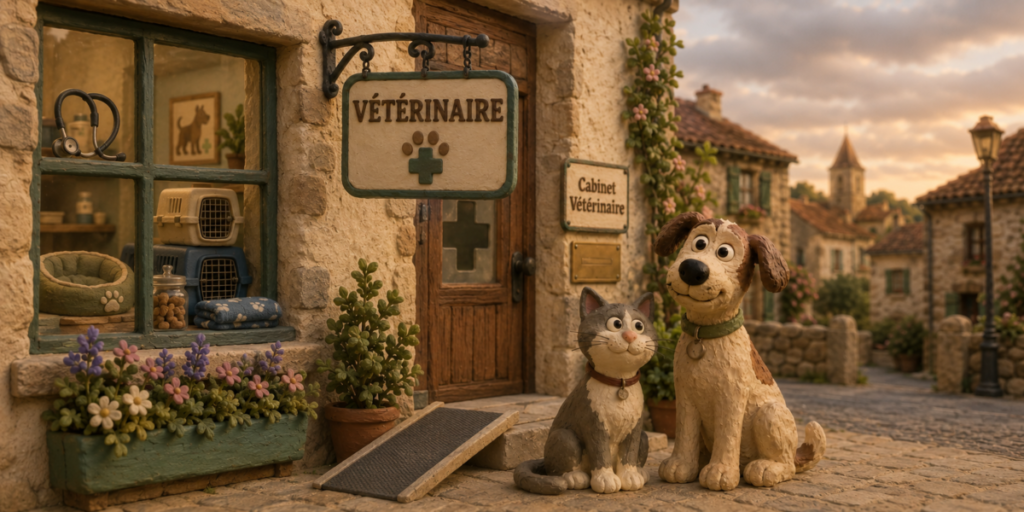
If you’re a UK-based dog owner who travels between Great Britain and France — whether for holidays, a second home, or to visit family — there’s a rule change from April 2026 that you really need to know about. And if someone has already mentioned it to you in passing, chances are you don’t yet have the full picture.

I’ve been hearing about this from a few of my clients and expat friends recently, so I wanted to put together a clear, straightforward summary. No jargon. Just what it actually means for you and your dog.


So What’s Changed?

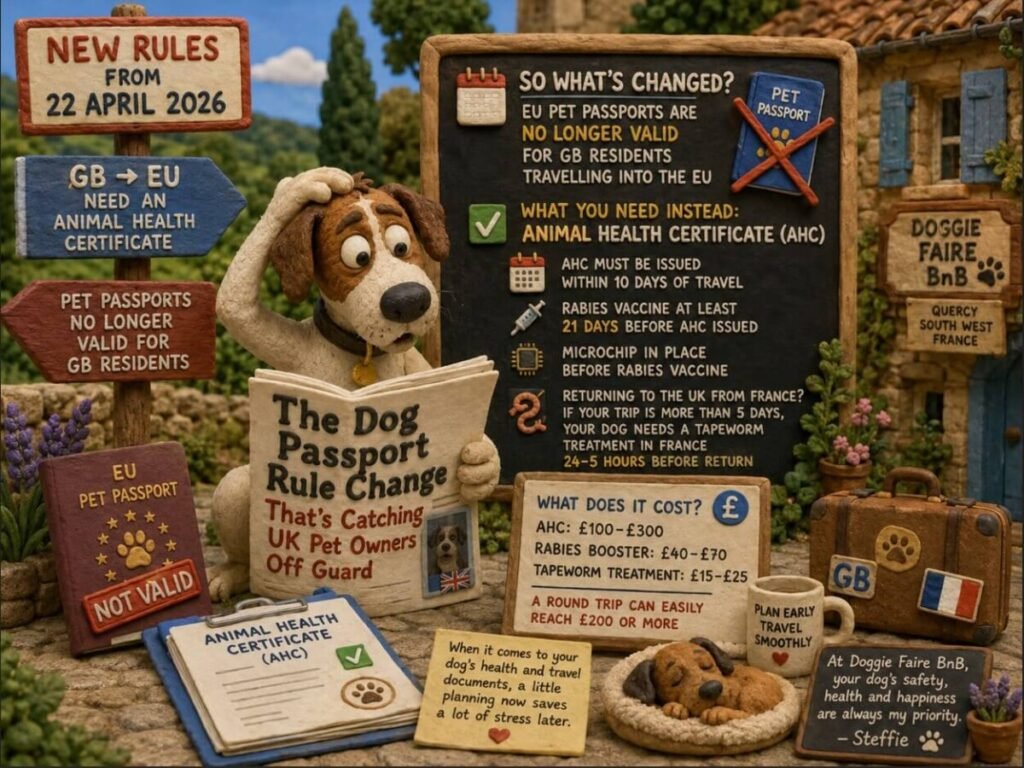
From 22 April 2026, new EU regulations came into force governing the movement of dogs, cats, and ferrets between Great Britain and EU countries — including France.

The headline? EU pet passports are no longer valid for GB residents travelling into the EU. That’s not a typo, and it’s not a Brexit hangover that was going to quietly resolve itself. It’s a formal regulatory change, and it applies even to EU-issued passports — even those issued before April 2026, even those from France or Ireland. If your main residence is in Great Britain, your pet passport is no longer accepted.

What you need instead is an Animal Health Certificate (AHC).


What Is an Animal Health Certificate?

An AHC is an official travel document issued by a government-authorised Official Veterinarian (OV) — not your regular vet, but one with specific government accreditation. It confirms that your dog meets all the health requirements to enter the EU.

Here’s the part that requires planning ahead:

  • The AHC must be issued within 10 days of your travel date
  • Your dog must have a current rabies vaccination, administered at least 21 days before the AHC is issued
  • Your dog must be microchipped (the chip must be in place before the rabies vaccine was given)
  • If you’re returning to the UK from France and your trip is more than five days, your dog will also need a tapeworm treatment, administered by a vet in France between 24 hours and five days before your return journey

That 21-day window for the rabies vaccine is the one that catches people out. If your dog’s rabies vaccination has lapsed, or has never been done, you cannot simply book an AHC appointment and travel the following week. You need to plan weeks in advance.


What Does It Cost?

This is where it gets a bit uncomfortable, because it’s considerably more expensive than the old passport system — and it’s a cost you’ll face on every single trip, not just the first one.

Expect to pay somewhere between £100 and £300 for the AHC itself, depending on your vet practice. Some specialist AHC providers charge from around £100 for a standard appointment; urgent bookings or general practices with less experience in travel documentation tend to be at the higher end. Add a rabies booster if one is due (£40–£70), and a tapeworm treatment on the return leg, and a round trip can easily reach £200 or more per journey.

It’s a significant change, particularly for people who cross regularly.


What About Those of Us Living in France?

If you’re a French resident — or an EU resident — with a French-issued pet passport, this change does not affect you in the same way. EU pet passports remain valid for those whose principal residence is within the EU. If you live here full-time and travel back to the UK occasionally with your dog, the rules for re-entering France on your return are what you’d need to check on the UK side.

For the many British expats and dual-country families in our part of South West France, the picture can be a little more complicated, so it’s well worth a conversation with your vet on both sides of the Channel.


A Word From Someone Who Cares About This Stuff

At Doggie Faire BnB, the health and documentation of every dog in my care matters enormously to me. Before any stay, I ask owners to confirm that vaccinations — including kennel cough — are fully up to date, and I take that seriously.

It’s one of the reasons I wanted to write about this change. I know from experience that a lot of loving, conscientious dog owners simply haven’t heard about it yet. The 21-day vaccine window in particular is the kind of detail that can derail travel plans very quickly if you discover it too late.

If you’re planning to bring your dog to France from the UK this summer — or to travel back to the UK with a dog currently staying in France — please do check the current AHC requirements with your vet as soon as possible. The earlier you start, the smoother it will be.

And if your dog ever needs a home-from-home base here in the Quercy while you’re sorting logistics, you know where I am.


Doggie Faire BnB offers cage-free, kennel-free in-home dog boarding in Montaigu-de-Quercy, Tarn-et-Garonne. Small-scale, personal, and genuinely family-style. Contact us today!

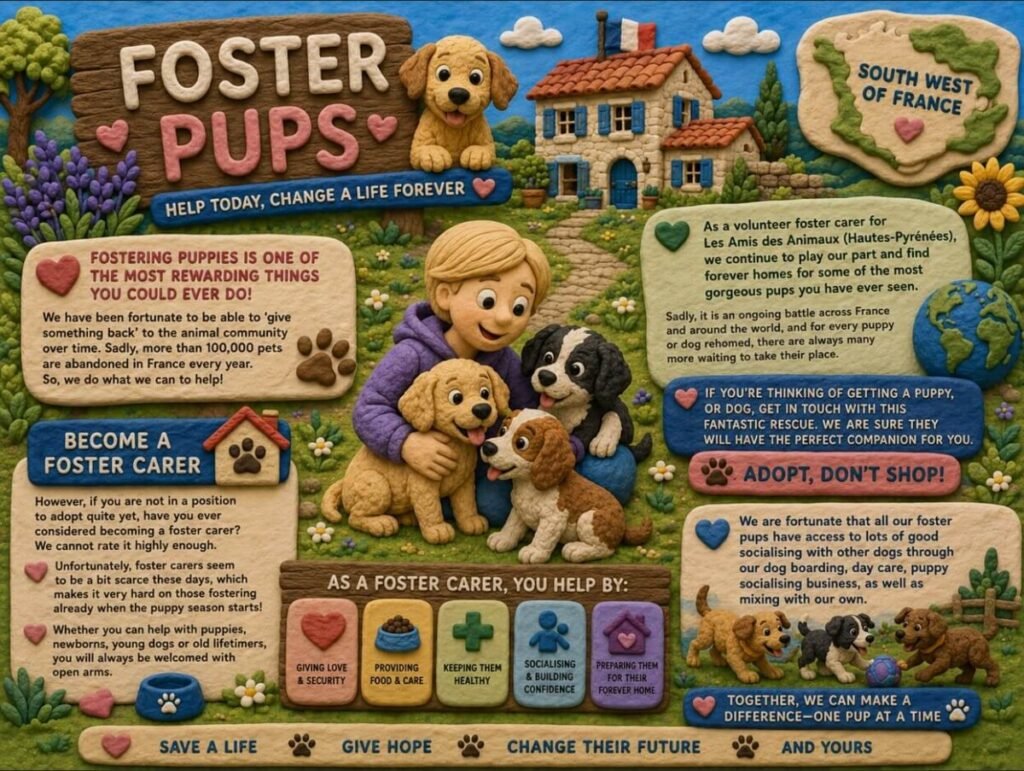
Foster Pups infographic from Doggie Faire BnB — promoting dog fostering and adoption with Les Amis des Animaux in South West France, Quercy.

Foster Pups: How In-Home Dog Boarding and Fostering Are Changing Lives in South West France

By Steffie | Doggie Faire BnB

Foster Pups infographic from Doggie Faire BnB — promoting dog fostering and adoption with Les Amis des Animaux in South West France, Quercy.

A Statistic That Should Stop Us All in Our Tracks

Over 100,000 pets are abandoned in France every year — and 60% of those cases happen during the summer holidays alone. France holds the unfortunate distinction of being the European champions for pet abandonment, a title no country should ever want.

At Doggie Faire BnB, I believe that responsible, compassionate animal care goes far beyond providing a safe place to sleep. It starts with giving something back to the wider animal community.

My Role as a Volunteer Foster Carer

Alongside running my cage-free pet sitting service here in Quercy, I volunteer as a foster carer for Les Amis des Animaux (Hautes-Pyrénées) — a fantastic rescue organisation working tirelessly to find forever homes for abandoned and surrendered dogs across the region.

Fostering is, without question, one of the most rewarding things I have ever done. Every pup that passes through my door gets love, stability, and a proper home environment — often for the very first time.

What Does a Foster Carer Actually Do?

❤️ Giving Love and Security

Many foster pups arrive unsettled, confused, or fearful. Simply providing a calm, warm, cage-free home environment makes an enormous difference to their confidence and recovery.

🍖 Providing Food and Care

Foster carers cover the day-to-day basics — feeding, grooming, and making sure each dog feels safe and nurtured.

🏥 Keeping Them Healthy

Monitoring health, flagging concerns to the rescue, and ensuring each dog is on track for their forever home placement.

🐾 Socialising and Building Confidence

This is where Doggie Faire BnB’s boarding environment really shines. All my foster pups benefit from socialising with other dogs through my dog boarding and day care — building the confidence and social skills that make them truly adoptable.

🏡 Preparing Them for Their Forever Home

The ultimate goal. Every walk, every cuddle, every nightly biscuit is a step closer to the life they deserve.

Why Foster Carers Are Desperately Needed Right Now

Unfortunately, foster carers are becoming increasingly scarce — which puts enormous pressure on those already fostering, especially when puppy season arrives.

Whether you can help with puppies, newborns, young dogs, or older lifetimers, you will always be welcomed with open arms. You don’t need to be perfect — you just need to care.

Not Ready to Foster? Please Consider Adoption

If you’re thinking of adding a dog or puppy to your family, please get in touch with a rescue organisation before heading to a breeder or pet shop.

Adopt, don’t shop. 🐾

Rescue dogs make extraordinary companions. They simply need someone to give them a chance.

Together, We Can Make a Difference — One Pup at a Time

The battle against pet abandonment in France is ongoing. For every dog rehomed, there are always more waiting. But with more foster carers, more adopters, and more awareness, we can turn the tide — one pup at a time. 💛

If you’d like to find out more about Les Amis des Animaux (Hautes-Pyrénées), or if you’re interested in fostering or adopting, please reach out — I’d love to point you in the right direction.

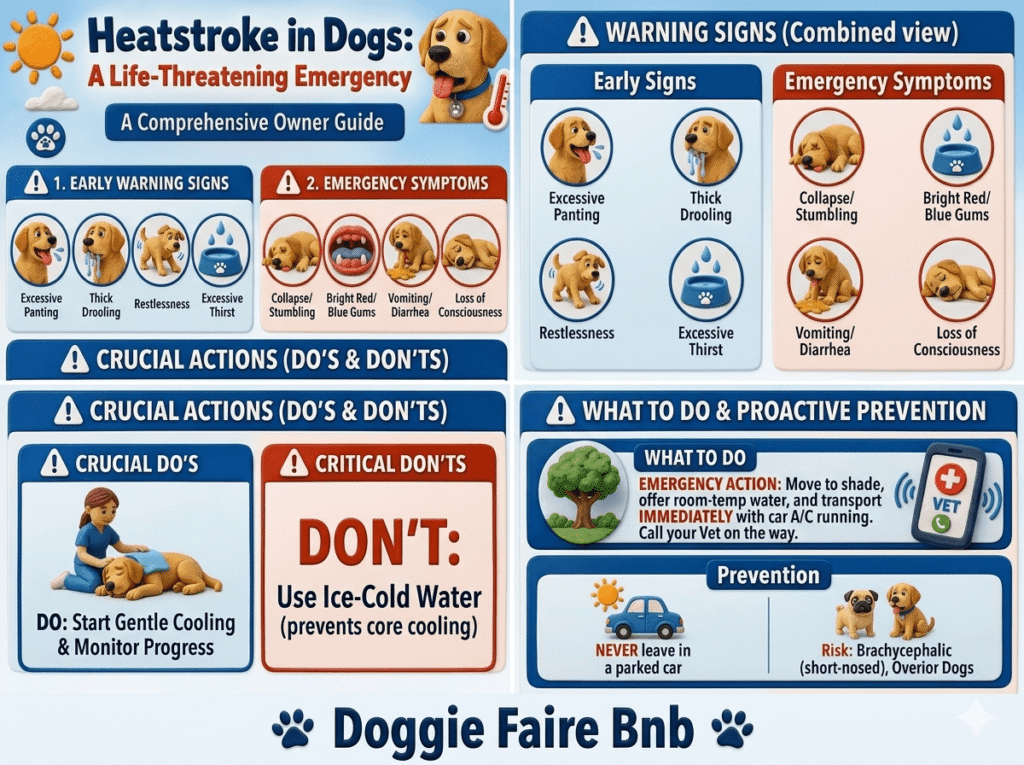
Doggie Faire Bnb heatstroke in dogs: Warning signs, emergency steps, and prevention guide.

Keeping Your Dog Safe: A Guide to Recognising and Preventing Heatstroke

By Steffie | Doggie Faire Bnb — In-Home Dog Boarding in the Quercy Region, South West France

As the temperatures begin to climb, we all look forward to spending more time outdoors with our furry friends. Whether it’s a trip to the park, a hike on the trails, or just hanging out in the garden, summer is a wonderful time for dogs.

However, heat poses a serious risk to our canine companions. Unlike humans, dogs cannot sweat through their skin to cool down; they rely primarily on panting to regulate their body temperature. This makes them significantly more susceptible to heatstroke, a life-threatening medical emergency that can progress in a matter of minutes.

Infographic by Doggie Faire Bnb on the signs and first aid for heatstroke in dogs.

Recognising the Signs of Heatstroke

Heatstroke doesn’t always start with a collapse. It is a spectrum, and catching the early warning signs can make all the difference in your dog’s recovery.

Early Warning Signs

  • Excessive, rapid panting: Persistent breathing that won’t slow down even when resting.
  • Thick, ropey drool: Excessive salivation or thick, sticky mucus.
  • Restlessness: An inability to find a comfortable position or settle down.
  • Intense thirst: A sudden, frantic need to drink.

Emergency Symptoms (Seek Veterinary Help Immediately)

  • Collapse or stumbling (ataxia): A clear sign of neurological distress.
  • Colour changes in gums/tongue: Look for bright red, purple, or even blue/grey tints.
  • Gastrointestinal distress: Vomiting or diarrhoea, which may contain blood.
  • Loss of consciousness: Stupor, seizures, or total unresponsiveness.

What to Do in an Emergency

If you suspect your dog is suffering from heatstroke, every second counts.

  1. Move to Shade: Immediately get your dog out of the sun and into a cool, shaded area.
  2. Gentle Cooling: Offer room-temperature water. Start by cooling them with room-temperature water or cool, damp towels.
  3. Important: Never place wet towels on top of your dog. This can trap heat against their body rather than allowing it to escape, which can dangerously increase their core temperature. Instead, place towels underneath them or use them to wipe their paws and belly.
  4. Transport Immediately: Call your vet while you are on the way. Keep the car air conditioning running to provide active airflow during transport.

The “Critical Don’t”

Never use ice-cold water. While it sounds counterintuitive, shocking a dog with ice-cold water causes blood vessels to constrict, which traps heat inside the body and can cause the dog’s temperature to plummet too far, leading to other serious medical complications.

Proactive Prevention

The best treatment for heatstroke is prevention. Here are the three non-negotiables for a safe summer:

  • Never leave a dog in a parked car: Not even for a minute, and not even with the windows cracked. Temperatures inside a vehicle can become lethal in less than 10 minutes.
  • Know your dog’s risk: Brachycephalic (short-nosed) breeds, senior dogs, and overweight dogs are at a much higher risk. Keep activities short and low-intensity for these pups.
  • Stay hydrated: Always have fresh, cool water and shade available whenever your dog is outside.

Disclaimer: This guide is for educational purposes. Always prioritise professional veterinary care if you suspect your pet is experiencing a medical emergency.

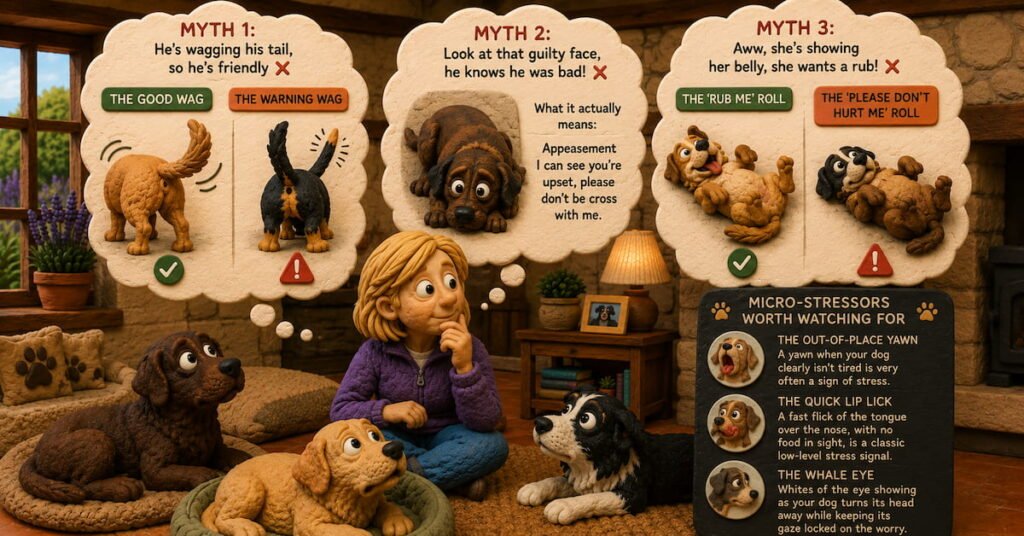
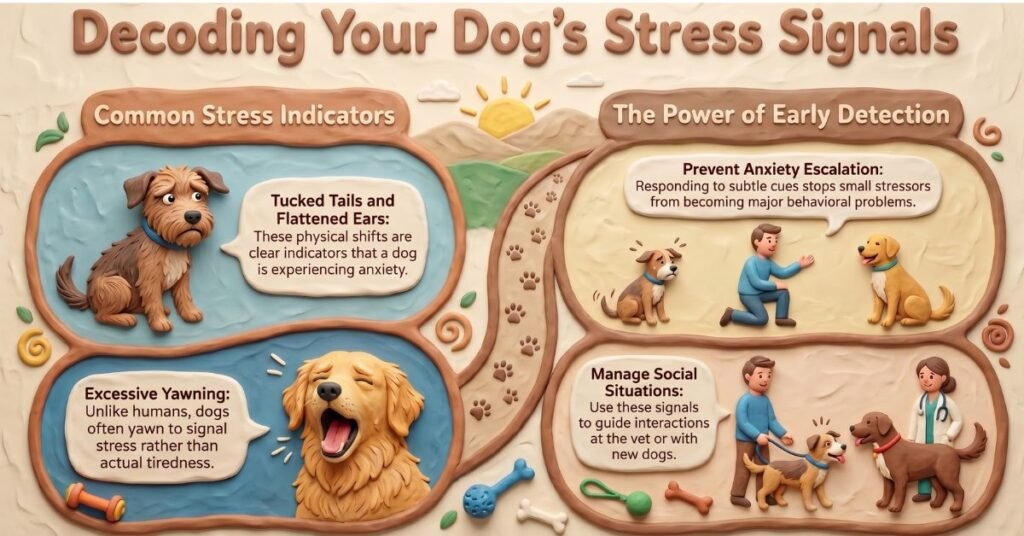
Infographic decoding common dog stress signals including tucked tails, flattened ears and excessive yawning, with early detection tips from Doggie Faire BnB in-home dog boarding in the Quercy, South West France

Decoding Your Dog’s Stress Signals: What I Watch For Every Day

By Steffie | Doggie Faire BnB — In-Home Dog Boarding in the Quercy Region, South West France
Infographic decoding common dog stress signals including tucked tails, flattened ears and excessive yawning, with early detection tips from Doggie Faire BnB in-home dog boarding in the Quercy, South West France

One of the things I genuinely love about having dogs in my home — rather than in a kennel or a commercial facility — is the time and space to actually watch them. Not from a distance. Not on a camera monitor. Up close, in the same room, doing nothing else.

And when you spend that kind of time with dogs, you start to notice things.

Not the obvious things — a growl, a snap, an outright refusal to engage. Those are easy to read. I mean the quieter things. The small, physical shifts that most people miss because they happen quickly, or because they don’t look like what we typically think of as “stress.”

Understanding those signals is something I consider a core part of what I do as an in-home dog boarder. And I think it’s something every pet parent benefits from knowing too — not just for boarding, but for life with their dog generally.


Common Stress Indicators: The Ones Worth Knowing

Tucked Tails and Flattened Ears

These are the stress signals most people have heard of, but they’re worth talking about properly because they’re often misread.

A tucked tail doesn’t always mean a dog is frightened of something specific. Sometimes it’s a low-level, ambient anxiety — the background hum of a dog who isn’t quite sure how to feel about a situation. The same goes for flattened ears. A dog can flatten their ears in a room that looks perfectly calm to us, because something in that environment — a smell, a sound, a dynamic between two other dogs — has registered as uncertain.

When I see these signals in a guest dog, I don’t ignore them and I don’t make a fuss of them. I simply adjust. Maybe that means creating more space. Maybe it means a quieter corner, a bit of distance from the other dogs, or just me sitting nearby without demanding anything. The response to the signal matters as much as spotting it in the first place.

Excessive Yawning

This one surprises people every time I mention it.

We yawn when we’re tired. Dogs yawn for an entirely different reason — or rather, for several reasons, and tiredness is actually fairly low on the list. Excessive yawning in dogs is most commonly a calming signal. It’s something dogs do to manage their own stress levels, and often to communicate to others around them that they’re feeling a bit overwhelmed.

A dog who yawns repeatedly during an introduction to another dog, or during a car journey, or in a new environment, is not bored. They’re working quite hard emotionally, and their body is doing what it can to self-regulate.

Once you know this, you start seeing it everywhere. And once you start seeing it, you can respond — which is the whole point.


The Power of Early Detection: Why It Matters So Much

Preventing Anxiety From Escalating

The reason I pay close attention to these early signals isn’t to be overly cautious — it’s because small stressors, left unaddressed, have a way of becoming large ones.

A dog who shows subtle signs of unease and gets no response learns, over time, that the subtle signals don’t work. So they escalate. The yawn becomes a lip curl. The flattened ears become a growl. The tucked tail becomes a freeze. By the time most people notice something is wrong, the dog has already been trying to communicate it for quite a while.

Catching things early — and responding to them — keeps that escalation from happening. It also, over time, builds a dog’s confidence in their own communication. A dog who learns that their quiet signals are heard and respected tends to become a calmer, more settled dog. That’s not a coincidence.

This is one of the reasons I believe that genuine personalised canine care — the kind that’s only really possible in a domestic, small-scale setting — makes such a practical difference to dogs in boarding. In a busy kennel environment, the staffing ratios and the noise levels make early detection genuinely difficult. Here, it isn’t.

Managing Social Situations

Dogs communicate with each other constantly, and a lot of that communication happens through exactly these signals — the yawns, the ear positions, the tail carriage, the subtle body language that passes between them in a fraction of a second.

Part of what I’m watching for when dogs are together isn’t just how they’re behaving toward each other, but whether those social interactions are comfortable ones. A dog who is yawning repeatedly near another dog is telling that dog — and me — something important. A dog whose tail drops when a particular companion approaches needs me to notice that and act on it.

Getting this right is part of how we maintain the calm, settled atmosphere that makes Doggie Faire BnB feel like a home rather than a holding facility. It’s not accidental, and it doesn’t happen without attention.


What This Means for You, as a Pet Parent

If your dog has ever come home from boarding and seemed a little flat, a little off, a little more clingy than usual — it’s worth considering whether their stress signals were being read during their stay.

Dogs are remarkably good at communicating how they feel. The gap is almost never on their end.

The more you know these signals yourself, the better conversations we can have about your dog before they arrive — and the better I can tailor their stay to suit them from day one.


Doggie Faire BnB offers cage-free pet sitting and in-home dog boarding in the Quercy region of South West France. We welcome enquiries from local families and expat communities across the area. Get in touch to find out more.

Doggie Faire BnB premium in-home dog boarding in South West France — cage-free family home boarding with limited spaces, the Meet-and-Greet process and the three busiest holiday booking periods in the Quercy

Holiday Season Is Coming — Why In-Home Dog Boarding Books Up Fast in the Quercy

By Steffie | Doggie Faire BnB — In-Home Dog Boarding in the Quercy, South West France

Infographic showing common dog stress signals including tucked tails, flattened ears and excessive yawning, with tips on early detection from Doggie Faire BnB in-home dog boarding, Quercy, South West France

If you’re planning a trip away — a summer holiday, a Christmas break, or even a long weekend — and you have a dog, you already know the question that comes next: “Who is going to look after them?”

For pet parents in the Quercy region of South West France, the answer is increasingly clear: in-home dog boarding with Doggie Faire BnB. But here’s the thing — we only take a small number of guests at any one time, and that means spaces fill up quickly, especially around the holidays.

If you’ve been thinking about booking, this post is your friendly nudge to do it sooner rather than later.

Why We Keep Numbers Small — On Purpose

Doggie Faire BnB is not a commercial kennel. It is a real family home, and that is precisely the point. Your dog doesn’t check into a facility — they come to live with us. They sleep on proper dog beds or sofas, explore a secure private garden, and receive genuinely personalised attention every single day.

To make that possible, we deliberately limit the number of dogs we board at any one time. This is the core difference between private dog sitting and a large commercial operation. It is also why we are never able to simply “squeeze one more in” during busy periods. When we are full, we are full.

The Seasons That Book Out First

There are three peak periods when enquiries spike significantly:

  • Summer holidays (July and August) — Families heading to the coast or abroad for two to three weeks. This is consistently our busiest period.
  • Christmas and New Year — International families travelling back to the UK, US, or elsewhere to see loved ones. Dogs cannot always make that journey, and a familiar, caring home environment is the next best thing.
  • French school holiday weeks — The Toussaint, February, and spring breaks bring a steady wave of bookings from local families.

A Note for International Pet Parents Moving to the Quercy

A significant number of our guests come from the international community — British, American, and other families from abroad who have made the Quercy their home. Many have told us that finding trusted, domestic-style dog care was one of their biggest concerns when they moved here.

Traditional kennels can feel like a significant step down from the home life their dogs are used to. Cage-free, in-home boarding offers something much closer to what their dog already knows: a sofa to curl up on, a garden to explore, and a human who genuinely loves dogs.

If that sounds like your situation, we would love to hear from you — and the sooner you reach out, the better your chances of securing a space during your travel dates.

The Meet-and-Greet: Why It Has to Come First

Before any dog joins us for their first boarding stay, we always insist on a trial daycare visit. This is not a formality — it is an essential step that protects your dog, the other guests in our care, and the harmony of our home.

Your dog comes to explore our home at their own pace, meets Steffie, and gets comfortable with the environment before the real stay begins. We use that visit to learn about their personality, their quirks, and what makes them feel settled. Only when we are confident it is the right fit do we confirm a booking.

This means that if you are hoping to board with us over the summer or at Christmas, the meet-and-greet needs to happen well in advance. It is one more reason why early enquiries always work in your favour.

What to Do Next

If you have an upcoming trip and you want to know whether we have availability, the best thing to do is get in touch now. Tell us your dates, a little about your dog, and we can let you know whether a meet-and-greet makes sense.

We are a small operation with a big heart — and the dogs who stay with us tend to come back again and again. That is the surest sign that what we offer is something genuinely different from a kennel alternative: it is a home.

Don’t leave it to the last minute. Get in touch with Steffie at Doggie Faire BnB today and secure your dog’s home away from home.

Doggie Faire BnB cage-free bedtime routine showing dogs settled on raised beds and nesting baskets in a warm home kitchen and lounge, Quercy, South West France

Sweet Dreams: Our Cage-Free Bedtime Routine at Doggie Faire BnB

By Steffie | Doggie Faire BnB — In-Home Dog Boarding in the Quercy, South West France

Doggie Faire BnB cage-free bedtime routine showing dogs settled on raised beds and nesting baskets in a warm home kitchen and lounge, Quercy, South West France

There’s a moment every evening, just as the light in the kitchen softens and the day starts to wind down, that I genuinely love. The dogs begin to settle. One does a slow circle on his bed and drops with a contented thump. Another is already curled into a neat comma in her basket, nose tucked under her tail. And somewhere by the door, there’s usually a hopeful face watching me, because they all know what’s coming next.

The nightly biscuit.

It sounds like a small thing. But that little ritual — that quiet, hand-delivered treat that signals the end of the day — is actually one of the most important things I do as an in-home dog boarder. Because routines aren’t just comforting for dogs. For a dog who is staying somewhere new, a predictable evening can be the difference between a peaceful night and an unsettled one.


Why the Evening Routine Matters More Than You’d Think

When a dog arrives at Doggie Faire BnB for the first time, they bring their whole world with them — their smell preferences, their sleep habits, their particular brand of bedtime anxiety (or blissful indifference, depending on the dog). What they don’t bring is certainty about what comes next.

In a kennel, the evening would mean noise — other dogs pacing and barking, hard floors, artificial light, the clang of gates. Here, it means something else entirely.

Because we offer cage-free pet sitting in a real family home, the evening routine unfolds exactly as it would in any loving household. The space gets quieter. The lights get lower. The humans settle. And the dogs, taking their cues from the atmosphere around them, settle too.

That rhythm of calm is something I protect deliberately. It doesn’t happen by accident.


How Bedtime Actually Works Here

The Space: Cage-Free Kitchen and Lounge

Our open-plan living space is where the dogs spend their evenings, and it’s been designed — or rather, lived in — with their comfort in mind. Sofas they’re welcome on. Dog beds positioned away from draughts. Rugs for those who like to sprawl. A kitchen that smells of proper food and feels like someone’s actual home, because it is.

There are no crates here at night. No pens. No “dog area” that exists apart from the rest of the house. Our guests sleep where the family sleeps — in the shared living space — because that’s what genuine domestic dog boarding looks like in practice.

For dogs who are used to sleeping near their people, this matters enormously. The sounds of a household at rest — breathing, the creak of floorboards, the distant rumble of the countryside outside — are settling sounds. They’re familiar in a way that silence in a kennel run simply isn’t.

The Bedding: Proper Rest for Proper Guests

Not every dog wants the same thing at bedtime, and over the years I’ve learned to pay attention to what each guest actually prefers.

Some dogs are raised-bed dogs — they like a bit of height, a firm surface, somewhere to survey the room from. For them, we have raised beds with duvets: proper, cushioned surfaces that support older joints and give a good night’s sleep.

Others are nesters. They want to burrow, to feel enclosed, to have fabric on all sides. For those dogs, we have small, plush nesting beds — the kind where they disappear entirely and you can only see a tail, if you’re lucky.

Getting the bedding right is part of personalised canine care that I take seriously. A dog who is physically comfortable is a dog who sleeps well. And a dog who sleeps well is a dog who is happy — which is ultimately what their owners are paying for.

The Atmosphere: Warmth, Quiet, and Soft Light

One thing I’m quite deliberate about is the atmosphere as the evening draws in. The day has a proper ending here. Bright overhead lights give way to something warmer and quieter. The pace slows. And by the time the dogs are settled for the night, the house is calm and dark — the way a home should be at that hour.

Dogs are exquisitely sensitive to atmosphere. They feel the shift in energy when a household winds down. Part of what makes in-home boarding so different from a kennel is that this shift actually happens here. There is a household. There is a rhythm. There is an evening — and then, genuinely, a night.

That winding-down isn’t a nice extra. For anxious dogs especially, it’s the foundation of everything.


The Nightly Biscuit: Small Ritual, Big Meaning

Every dog who stays with us gets a final treat delivered by hand before I say goodnight.

It’s not complicated. It doesn’t need to be. But what it does — consistently, reliably, night after night — is signal the end of the day in a way dogs understand immediately. This is the last thing. Now we rest.

For dogs who have been with us a while, they often start looking for it before I’ve even moved toward the kitchen. That recognition, that anticipation — that’s a dog who has learned the routine. And a dog who has learned the routine is a dog who feels safe.

For me, it’s also just one of the loveliest parts of the day. There’s something quietly wonderful about standing in a warm, low-lit kitchen, handing out biscuits to a handful of sleepy dogs who are already halfway to dreaming. If you’ve ever wondered what cage-free dog boarding actually looks like in the evenings — this is it.


What This Means for You, as a Pet Parent

When you leave your dog with us, you’re not leaving them somewhere that shuts down into silence and fluorescent light at 7 pm. You’re leaving them in a home that has an evening. A proper one.

They’ll have a comfortable bed chosen with their sleep style in mind. They’ll have a calm, settled atmosphere rather than a noisy one. They’ll have the reassurance of a consistent routine. And they’ll have their biscuit.

If you’d like to know more about how we manage evenings, I’m always happy to talk it through.


Doggie Faire BnB offers cage-free pet sitting and in-home dog boarding in the Quercy region of South West France. We welcome enquiries from local families and expat communities across the area. Get in touch to arrange your dog’s Meet-and-Greet.

dog boarding meet and greet

Dog Boarding Meet and Greet: Why It’s the First Step to Every Doggie Faire BnB Stay

Before any dog crosses our threshold as a boarding guest, they come to say hello first. Here’s why that matters — and what it actually involves.

dog boarding meet and greet

Every enquiry we receive at Doggie Faire BnB follows the same path. We have a conversation, we learn about your dog, and if it sounds like a good fit, the next step is always the same: a Meet-and-Greet. Not a provisional booking. Not a holding deposit. A visit.

This isn’t a box-ticking exercise or a formality we’ve added to look thorough. It is the single most important step in our process — and understanding why tells you a great deal about how we operate and what we stand for.


What Is a Dog Boarding Meet and Greet?

A Meet-and-Greet is a trial visit to our home in the Quercy region of South West France, arranged before any boarding stay is confirmed. Your dog comes to spend time here — exploring the space, meeting Steffie, and getting to know any dogs who are currently in residence..

It is, in essence, a dry run. A chance for everyone involved — your dog, our current pack, and us — to establish whether this is the right fit before any commitment is made on either side.

At Doggie Faire BnB, this visit is mandatory for all new guests, without exception.


Why Is It Non-Negotiable?

The answer lies in how we operate.

Because our home is 100% cage-free and kennel-free, every dog who stays here moves freely through the living space. There are no separate runs, no partitioned areas, no way to keep dogs apart once a stay has begun. Dogs sleep on beds and sofas alongside each other, share the garden, and spend their days as a small, informal pack.

That environment is wonderful — but it only works when the dogs in it are genuinely compatible.

Pack Harmony Is Everything

We use the phrase pack harmony deliberately. It describes the calm, settled dynamic that exists when a small group of dogs simply gets along — not perfectly, not without the odd grumble, but without tension, stress, or conflict that would affect the wellbeing of any individual dog.

Introducing a new dog into that dynamic without preparation is a risk we are not willing to take. Not with the dogs already in our care, and not with yours.

The Meet-and-Greet is how we protect that harmony. It gives us — and the dogs — the information we need before anyone is committed to a stay.

We Need to Be Honest About Suitability

We would rather tell you at the Meet-and-Greet stage that our home isn’t the right environment for your dog than have that become apparent after you’ve already left for your holiday.

Some dogs, through no fault of their own, are not suited to in-home dog boarding in a shared, cage-free environment. They may be uncomfortable around other dogs, or simply need a level of space and solitude that our home cannot provide. That’s not a failure — it’s just information, and it’s far better to have it early.

The Meet-and-Greet is where we find out.


What Actually Happens During a Meet-and-Greet?

Your Dog Explores the Home and Garden

From the moment they arrive, your dog is free to investigate the space at their own pace. The house, the garden, the smells, the layout — all of it. This isn’t just pleasant for them; it’s genuinely useful. A dog who has already pottered around our garden and sniffed every corner of the sitting room arrives on boarding day somewhere that already feels familiar, not foreign.

They Meet Steffie

This is where the foundation of trust begins. Your dog will interact with Steffie — on their own terms, without pressure — and start to establish her as someone safe and known. In a private dog sitting environment where there is one consistent caregiver rather than a rotating staff, that relationship is everything. It starts here.

They Meet the Current Pack

This is the heart of the Meet-and-Greet. Your dog will be introduced to whoever else is currently staying with us, and our own dogs,  in a calm and supervised setting. We watch how the dogs interact, how quickly they settle with each other, and whether the social dynamic feels easy and natural. We are looking for compatibility, not perfection — but we are looking carefully.

We Talk

After the Meet-and-Greet, we have the chance to talk. About your dog’s routine, their preferences, their quirks, any medication they take, what they eat and when. The more we understand about your dog before they arrive, the better their stay will be. The Meet-and-Greet is when that understanding begins.


What Happens After the Meet-and-Greet?

If the visit goes well — and for the right dogs, it usually does — we confirm the booking and agree the details of the stay. Your dog leaves having had a positive experience in our home, with a sense of Steffie and the space already established.

If we have any concerns, we will always be honest with you. That might mean suggesting a longer trial session before committing to an overnight stay, or it might mean acknowledging that our environment isn’t the right fit. Either way, you leave with clarity — which is always more useful than false reassurance.


What the Meet-and-Greet Is Not

It is worth being clear about this, because we want to set the right expectations.

The Meet-and-Greet is not a guaranteed path to booking. We reserve the right — and the responsibility — to decline a booking if we feel it isn’t in the best interests of your dog or our current guests. This isn’t something we do lightly, but it is something we do when necessary.

It is also not a lengthy or stressful process for your dog. For most dogs, it’s simply a nice morning out — a new place to explore, some new friends to meet, and a biscuit or two along the way.


How to Arrange a Meet-and-Greet

The first step is always a conversation. Get in touch and tell us what you’re looking for. If it sounds promising on both sides, we’ll arrange a time for you to bring them over.

There’s no commitment required at that stage. Just a visit, an honest conversation, and the beginning of what we hope will be a relationship built on trust — for you, for us, and most importantly, for your dog.

Doggie Faire BnB — in-home dog boarding and cage-free pet sitting in the Quercy region of South West France. Serving local families and expat communities across the area.

Luxury In-Home Boarding Guide

Why Your Dog’s Next Holiday Should Feel Nothing Like a Kennel

There’s a better way — and it’s right here in the heart of the Quercy countryside.

Luxury In-Home Boarding Guide

Leaving your dog behind when you head off on holiday is one of those things that never quite gets easier. You pack your bags, you double-check the arrangements, and somewhere in the back of your mind, you picture the hollow clang of a kennel gate closing. For most of us, traditional boarding has simply been the default — not because it’s good, but because we didn’t know there was another way.

At Doggie Faire BnB, we’re here to tell you: there absolutely is.


The Problem with Traditional Kennels (That Nobody Talks About Enough)

Let’s be honest about what a standard boarding kennel actually looks and feels like for a dog. The noise alone — echoing barks, metal gates, hard floors — creates a level of sensory stress that most of us would find unbearable after an hour, let alone several days. Add to that the rotating staff, the concrete runs, and the sheer volume of animals being managed on a tight schedule, and it becomes clear: traditional kennels are built around operational efficiency, not canine wellbeing.

That’s not a criticism of the people who work in them. It’s simply a fundamental design problem.

Your dog didn’t choose to go on holiday without you. The least we can do is make sure that while you’re away, they’re somewhere that actually feels like home.


What In-Home Dog Boarding Actually Means

Doggie Faire BnB is not a facility. It’s not a business premises with dog-sized rooms. It is a real family home — nestled in the beautiful Quercy region of South West France, where your dog comes to stay as a genuine guest.

100% Cage-Free. Always.

There are no cages here. No crates used for containment. No kennel runs. Dogs sleep on proper dog beds and sofas in the living areas of the house, exactly as they would at home. This isn’t a marketing phrase — it’s the non-negotiable foundation of everything we do.

For dogs who are used to sleeping on the sofa or at the foot of the bed, arriving somewhere and being shut in a crate overnight can be genuinely distressing. Here, that simply doesn’t happen.

Small Numbers by Design

We take only a small number of guests at any one time. This is an intentional choice — and it’s what makes genuine, personalised care possible.

When you’re not managing a crowd, you can actually notice things. Which dog prefers the sunny spot by the garden door. Which one needs a quiet five minutes after a walk before they’re ready to play. Which one is a little nervous at mealtimes and needs a reassuring hand nearby. This is the kind of attentiveness that simply cannot exist in a high-volume operation.

Small-scale in-home dog boarding isn’t a limitation. It’s the whole point.


The Meet-and-Greet: Our Most Important Step

Before any booking is confirmed, every new guest must complete a mandatory trial session — what we call the Meet-and-Greet.

This isn’t a formality. It’s the cornerstone of how we keep every dog safe and settled.

What It’s For

Because our home is cage-free, all dogs move freely through the space together. That means social compatibility — what we call pack harmony — matters enormously. A dog who is anxious around other dogs, or whose personality clashes with the current guests, won’t be happy here regardless of how lovely the environment is.

The Meet-and-Greet gives your dog the chance to:

  • Explore the home at their own pace
  • Meet the owner and build initial trust
  • Interact with any current canine guests in a calm, supervised setting
  • Simply be in the space before committing to a longer stay

And it gives us the chance to make sure your dog is the right fit for our current pack — and vice versa.

We’d rather be honest at this stage than have a dog who is stressed or unsettled once you’ve already left for your holiday.


Health & Safety: The Invisible Framework

A cage-free environment is only possible when the safety foundations are rock solid. Here’s what we require of every guest:

Vaccinations

All dogs must be current with their CHPPiL / DHPPiL vaccinations, including kennel cough cover. This is non-negotiable and protects every dog in our care.

Parasite Prevention

Up-to-date flea, tick, and worming treatments are required before any stay. Living in South West France, where ticks in particular can be a real concern, this isn’t bureaucracy — it’s basic responsibility.

The Home Environment

Our home is fully dog-proofed, and the private garden is securely enclosed, giving dogs the freedom to sniff, mooch, and enjoy the fresh Quercy air without risk.

These aren’t rules for the sake of rules. They’re what make the cage-free promise possible.


Who We’re Here For

Doggie Faire BnB is a natural fit for:

  • Expat families (particularly from the US, UK, and beyond) based in South West France who want their dog cared for by someone who truly understands the standard they’re used to
  • Local pet parents in the Quercy region looking for a genuine kennel alternative with personalised, private care
  • Anyone whose dog would struggle in a traditional kennel environment — whether through anxiety, age, medication needs, or simply being thoroughly spoiled at home (no judgement — same here)

A Note on What We’re Not

We are a private dog sitter offering domestic dog boarding in a real family home. We are not:

  • A commercial kennel
  • A doggy hotel with multiple members of staff
  • A facility that takes every enquiry regardless of fit

We are a home, and a small, carefully chosen group of dogs who live alongside each other in comfort and companionship while their families are away.


The Quercy Countryside as a Backdrop

There’s something particularly wonderful about the rhythm of life here in the Quercy region. Long walks through the countryside, afternoons in the garden, the slower pace that makes South West France so special for the people who choose to live here — and, it turns out, for dogs too.

Your dog doesn’t know they’re on holiday. But with the right care, they won’t know they’re missing you either.


Ready to Find Out If We’re the Right Fit?

The first step is always a conversation. Tell us about your dog — their personality, their quirks, their routine — and we’ll be honest with you about whether Doggie Faire BnB sounds like the right match.

If it does, we’ll arrange a Meet-and-Greet, and take it from there.

Because your dog deserves more than a slot in a rota. They deserve a home away from home.


Doggie Faire BnB — in-home dog boarding and cage-free pet sitting in the Quercy region of South West France. Serving local families and expat communities across the area.