By Steffie | Doggie Faire BnB — In-Home Dog Boarding in the Quercy Region, South West France
One of the things I genuinely love about having dogs in my home — rather than in a kennel or a commercial facility — is the time and space to actually watch them. Not from a distance. Not on a camera monitor. Up close, in the same room, doing nothing else.
And when you spend that kind of time with dogs, you start to notice things.
Not the obvious things — a growl, a snap, an outright refusal to engage. Those are easy to read. I mean the quieter things. The small, physical shifts that most people miss because they happen quickly, or because they don’t look like what we typically think of as “stress.”
Understanding those signals is something I consider a core part of what I do as an in-home dog boarder. And I think it’s something every pet parent benefits from knowing too — not just for boarding, but for life with their dog generally.
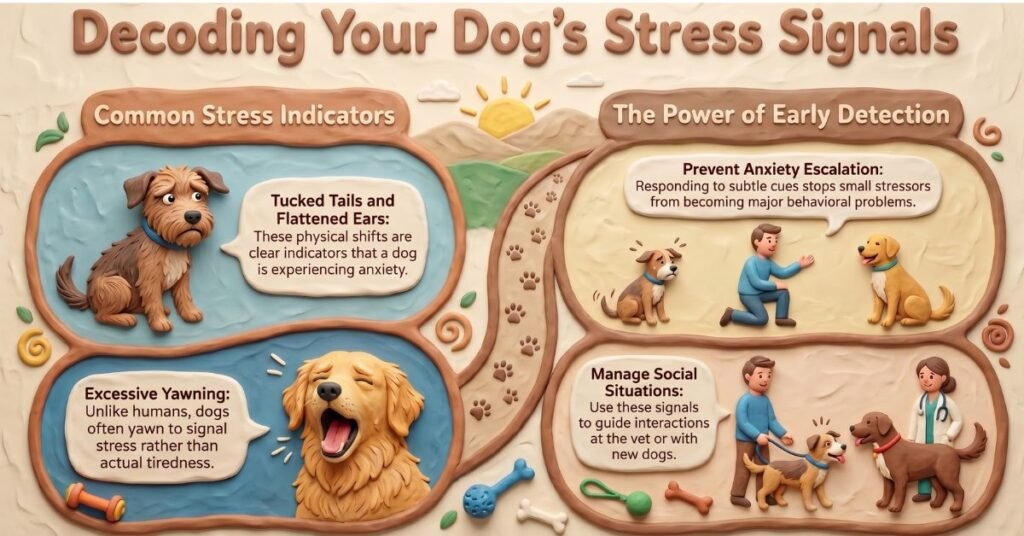
Common Stress Indicators: The Ones Worth Knowing
Tucked Tails and Flattened Ears
These are the stress signals most people have heard of, but they’re worth talking about properly because they’re often misread.
A tucked tail doesn’t always mean a dog is frightened of something specific. Sometimes it’s a low-level, ambient anxiety — the background hum of a dog who isn’t quite sure how to feel about a situation. The same goes for flattened ears. A dog can flatten their ears in a room that looks perfectly calm to us, because something in that environment — a smell, a sound, a dynamic between two other dogs — has registered as uncertain.
When I see these signals in a guest dog, I don’t ignore them and I don’t make a fuss of them. I simply adjust. Maybe that means creating more space. Maybe it means a quieter corner, a bit of distance from the other dogs, or just me sitting nearby without demanding anything. The response to the signal matters as much as spotting it in the first place.
Excessive Yawning
This one surprises people every time I mention it.
We yawn when we’re tired. Dogs yawn for an entirely different reason — or rather, for several reasons, and tiredness is actually fairly low on the list. Excessive yawning in dogs is most commonly a calming signal. It’s something dogs do to manage their own stress levels, and often to communicate to others around them that they’re feeling a bit overwhelmed.
A dog who yawns repeatedly during an introduction to another dog, or during a car journey, or in a new environment, is not bored. They’re working quite hard emotionally, and their body is doing what it can to self-regulate.
Once you know this, you start seeing it everywhere. And once you start seeing it, you can respond — which is the whole point.
The Power of Early Detection: Why It Matters So Much
Preventing Anxiety From Escalating
The reason I pay close attention to these early signals isn’t to be overly cautious — it’s because small stressors, left unaddressed, have a way of becoming large ones.
A dog who shows subtle signs of unease and gets no response learns, over time, that the subtle signals don’t work. So they escalate. The yawn becomes a lip curl. The flattened ears become a growl. The tucked tail becomes a freeze. By the time most people notice something is wrong, the dog has already been trying to communicate it for quite a while.
Catching things early — and responding to them — keeps that escalation from happening. It also, over time, builds a dog’s confidence in their own communication. A dog who learns that their quiet signals are heard and respected tends to become a calmer, more settled dog. That’s not a coincidence.
This is one of the reasons I believe that genuine personalised canine care — the kind that’s only really possible in a domestic, small-scale setting — makes such a practical difference to dogs in boarding. In a busy kennel environment, the staffing ratios and the noise levels make early detection genuinely difficult. Here, it isn’t.
Managing Social Situations
Dogs communicate with each other constantly, and a lot of that communication happens through exactly these signals — the yawns, the ear positions, the tail carriage, the subtle body language that passes between them in a fraction of a second.
Part of what I’m watching for when dogs are together isn’t just how they’re behaving toward each other, but whether those social interactions are comfortable ones. A dog who is yawning repeatedly near another dog is telling that dog — and me — something important. A dog whose tail drops when a particular companion approaches needs me to notice that and act on it.
Getting this right is part of how we maintain the calm, settled atmosphere that makes Doggie Faire BnB feel like a home rather than a holding facility. It’s not accidental, and it doesn’t happen without attention.
What This Means for You, as a Pet Parent
If your dog has ever come home from boarding and seemed a little flat, a little off, a little more clingy than usual — it’s worth considering whether their stress signals were being read during their stay.
Dogs are remarkably good at communicating how they feel. The gap is almost never on their end.
The more you know these signals yourself, the better conversations we can have about your dog before they arrive — and the better I can tailor their stay to suit them from day one.
Doggie Faire BnB offers cage-free pet sitting and in-home dog boarding in the Quercy region of South West France. We welcome enquiries from local families and expat communities across the area. Get in touch to find out more.